Procedures
Install Java
HID Global Validation Authority requires a Java Development Kit (JDK), not a Java Runtime Environment (JRE). For VA 7.5, HID lists the Microsoft Build of OpenJDK 17.0.12 as a supported version.
-
Download and install the Microsoft Build of OpenJDK for all users.
In the installer, enable Modify PATH variable and Set or override JAVA_HOME variable. -
Open a new PowerShell window and verify that the JDK is available:
java -version
javac -version
$env:JAVA_HOME
Confirm
javaandjavacreport the expected JDK version.
Install the HSM
Install the nShield Connect HSM locally, remotely, or remotely via the serial console. See the following nShield Support articles and the Installation Guide for the HSM:
| Access to the Entrust nShield Support Portal is available to customers under maintenance. To request an account, contact nshield.support@entrust.com. |
-
Install the Security World software on the Windows server running HID VA.
Ensure the client components are installed and that the Security World utilities are available in the system
PATH. Restart the server after installation.Refer to the nShield Security World documentation for more information.
-
Use your organization’s approved HSM administration workflow to register the Windows server running HID VA as an HSM client.
-
In an elevated PowerShell window on the HID VA server, enroll the client with each HSM:
nethsmenroll <HSM-IP-address> -
Confirm that the HSM is operational by running
enquiry.For a high-availability setup, confirm that each HSM is listed and operational. Confirm that the server can reach each HSM over TCP port
9004before continuing. -
Load an approved existing Security World or create one according to your organization’s Security World policy.
Do not copy Security World files from an unverified source. -
Run
nfkminfoand confirm that the World state and the target module state are bothusable. -
Run
nfkmcheckand confirm that it reportseverything seems to be in orderbefore continuing. -
Configure the client ports in
C:\ProgramData\nCipher\Key Management Data\config\config:In the
[server_startup]section, set the following values, verifying and editing existing settings rather than adding duplicates:[server_startup] priv_port=9001 nonpriv_port=9000 -
If you changed the port values, restart the hardserver. The new ports take effect when the hardserver next starts.
-
If cardlist allowlisting is enabled, authorize the OCS card or cards required by HID VA using your organization’s card-management policy.
Do not use a wildcard allowlist entry in a customer environment.
Create the OCS
-
Create the OCS with a 1-of-N quorum. Choose N in accordance with your organization’s security policy.
Administrator Card Set (ACS) authorization is required to create an OCS in FIPS 140 level 3.
After an OCS card set has been created, the cards cannot be duplicated.
createocs -m1 -s2 -N <OCS-name> -Q <K>/<N> -
Confirm the OCS is listed with the expected name and quorum:
nfkminfo -c
Configure Java for nShield
Copy the nShield Java provider into the library directory of the selected JDK:
Copy-Item "$env:ProgramFiles\nCipher\nfast\java\classes\nCipherKM.jar" "$env:JAVA_HOME\lib\"Install Microsoft SQL Server
HID VA 7.5 documentation lists SQL Server 2019 Express, Standard, and Enterprise editions. SQL Server 2025 has also been tested successfully, but HID does not list it as an officially supported version. Use approved installation media; setup screens and options may vary by SQL Server release.
-
Run
setup.exeas Administrator and select a new stand-alone SQL Server installation. -
Install Database Engine Services. Use the default instance when available. If you use a named instance, record its name for later configuration.
-
For the Database Engine Configuration, select Mixed Mode.
-
Add the Windows account that will create the HID VA database as a SQL Server administrator and set a strong administrator password in accordance with your organization’s policy.
-
In SQL Server Configuration Manager, enable TCP/IP for the instance:
-
Set IPAll to a fixed TCP port,
1433. -
Clear TCP Dynamic Ports.
-
Restart the SQL Server instance.
-
-
Verify that SQL Server is listening on port
1433and thatTest-NetConnection -ComputerName localhost -Port 1433succeeds before configuring HID VA.
When SQL Server and HID VA are on the same machine, do not add an inbound firewall rule for port 1433.
For a separate database server, use its hostname and restrict inbound TCP 1433 to the HID VA server’s address.
Configure the HID VA database
-
Create a database named
rtcto store HID VA issuer, credential, and revocation-list data. Do not create the VA tables manually; the HID configuration wizard creates them. -
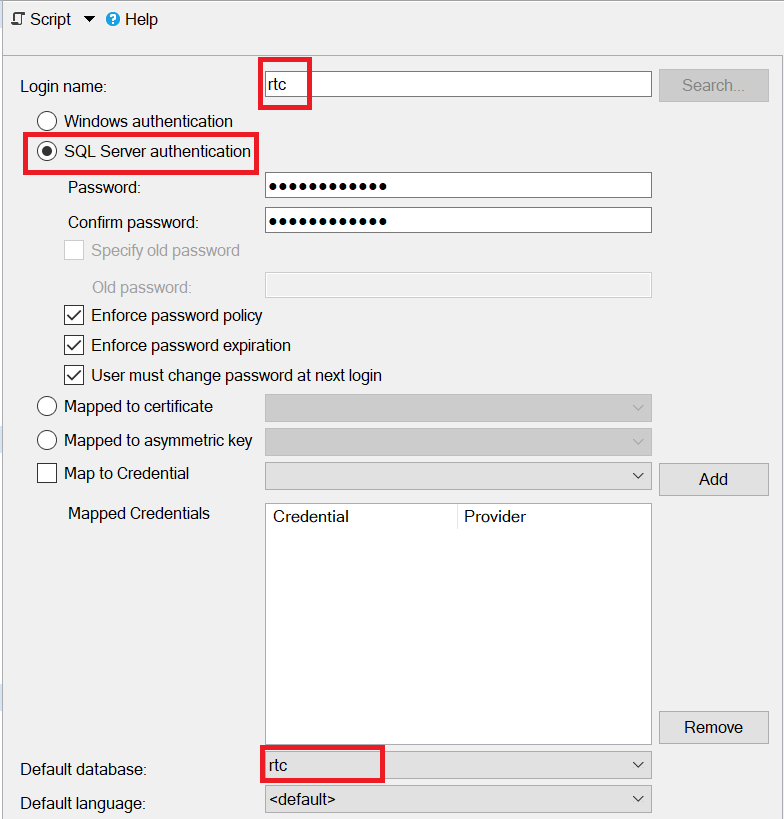
Create a new login:
-
For Login name, enter
rtc. -
Select SQL server authentication.
-
Enter and confirm a Password.
-
For Default database, select rtc.
-
Enable password policy and expiration in accordance with your organization’s account policy.
For example:
-
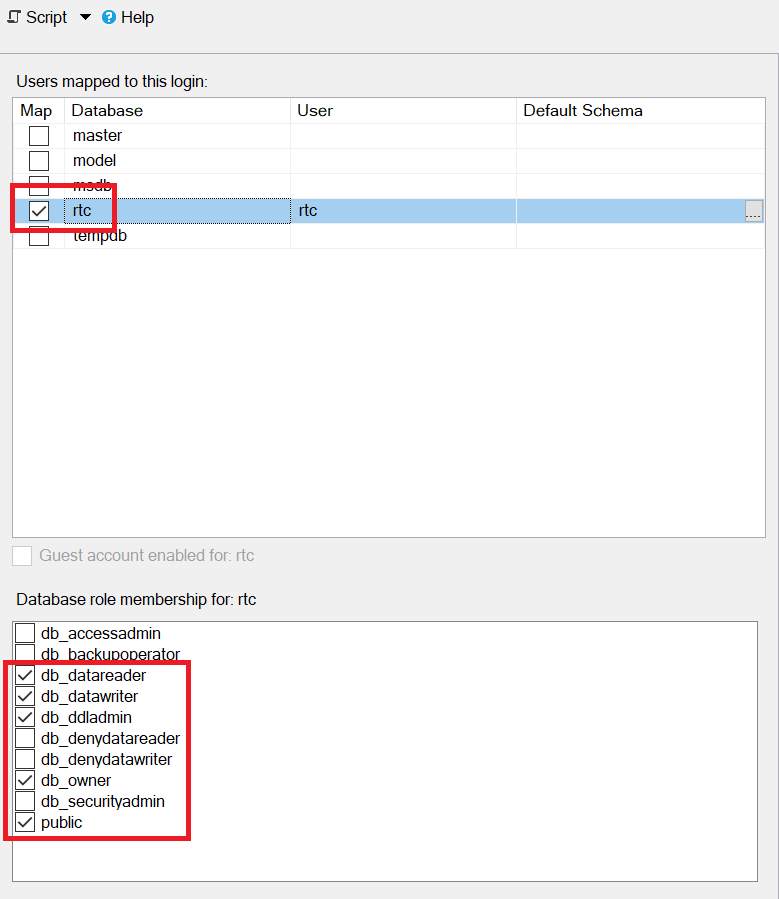
For Users mapped to this login, select rtc.
-
For Access privilege, select db_datareader, db_datawriter, db_ddladmin, and db_owner.
Membership in public is automatic; do not grant the login server-level sysadmin access for the application.
For example:
-
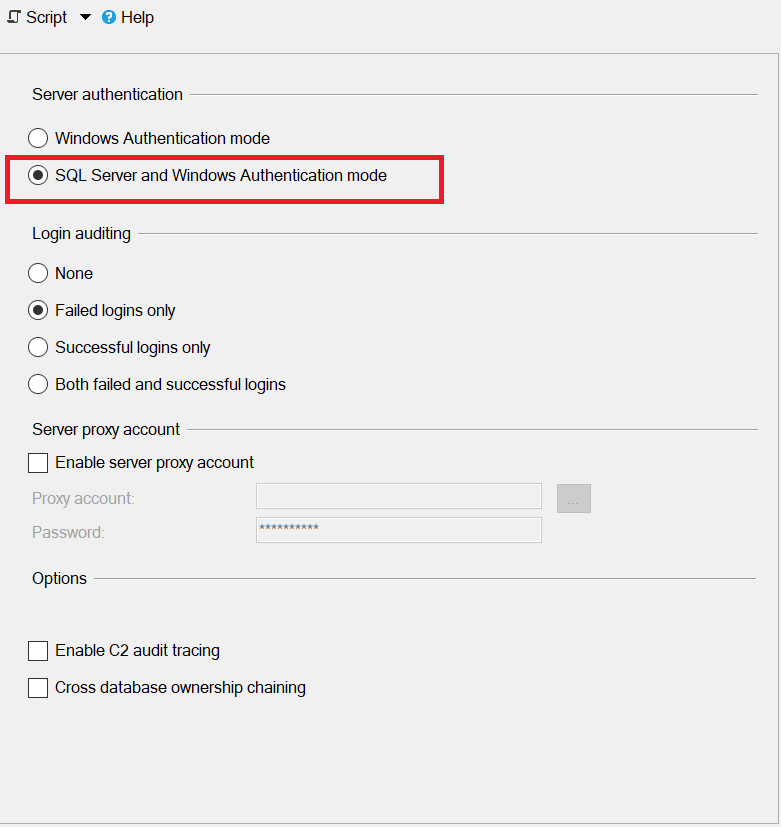
For Server authentication, select SQL Server and Windows Authentication mode.
-
-
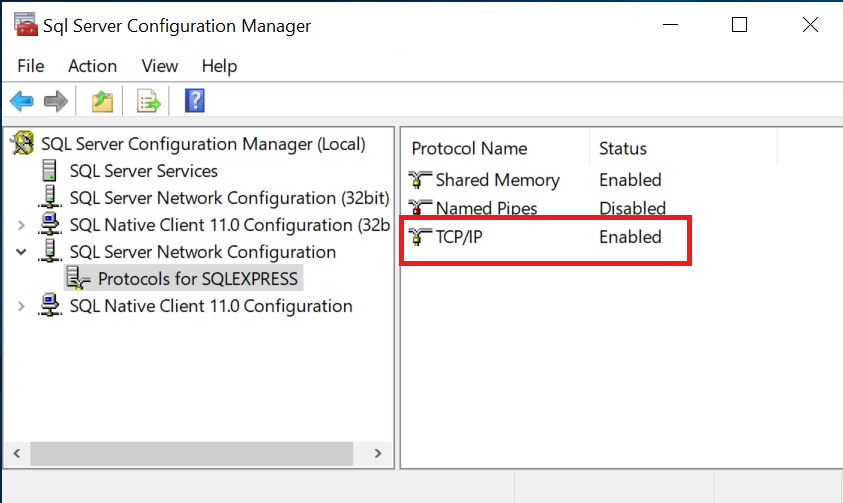
Enable the TCP/IP network protocol.
-
Verify that Mixed Mode authentication is enabled and that the SQL Server instance is listening on TCP port
1433. Do not open inbound port1433when SQL Server and HID VA run on the same machine. -
Verify the
rtclogin usingsqlcmd.Because
-Pis omitted, the command prompts for the SQL password instead of placing it on the command line:sqlcmd -S tcp:localhost,1433 -U rtc -C -b -Q "SELECT ORIGINAL_LOGIN() AS LoginName, DB_NAME() AS DatabaseName; SELECT IS_MEMBER('db_owner') AS IsDatabaseOwner;"Confirm the following details:
-
LoginNameisrtc -
DatabaseNameisrtc -
IsDatabaseOwneris1
Do not use the
saaccount for the HID VA database connection. -
Install the HID Global Validation Authority
The following steps describe how to install HID VA 7.5 on Windows. For other releases, use the matching ActivID® Validation Authority Installation and Configuration Guide and installer package.
-
From the HID customer portal, download the full HID Validation Authority 7.5 software ZIP.
-
Extract the ZIP to a local staging folder; do not run the installer from inside the archive.
-
Locate the installer in the extracted
Productsfolder and confirm that the nShield Java provider is installed.
If VA is already installed, exit the installer on its first page. Do not select a repair, removal, or installation option. -
Run the installer from the extracted
Productsfolder, using the JDK selected for HID VA. -
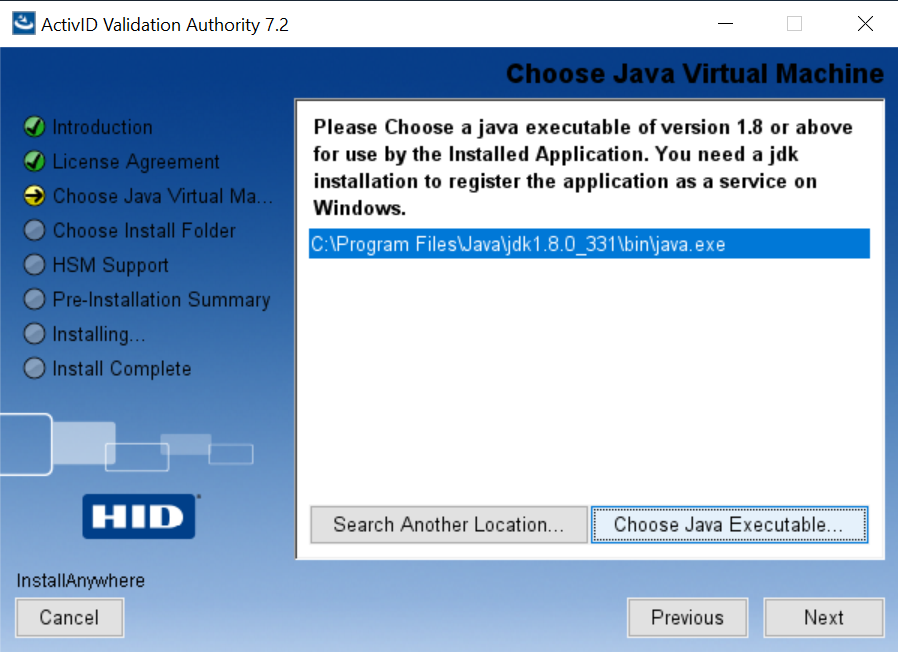
On the Choose Java Virtual Machine page of the installer, choose the Java executable within the JDK folder.
-
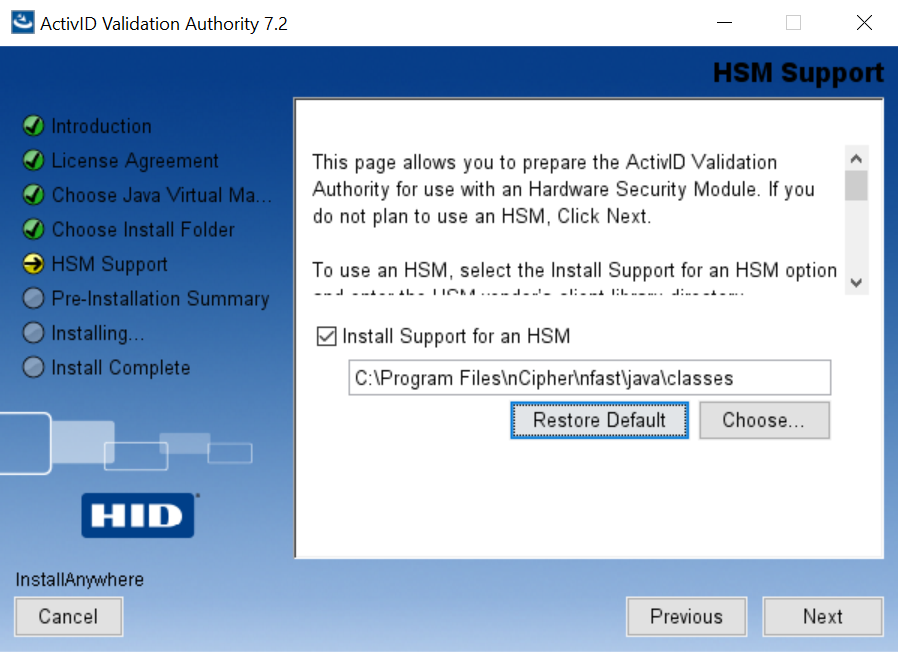
On the HSM Support page of the installer:
-
Select Install Support for an HSM.
-
Select Choose and find
%NFAST_HOME%\java\classes.
-
-
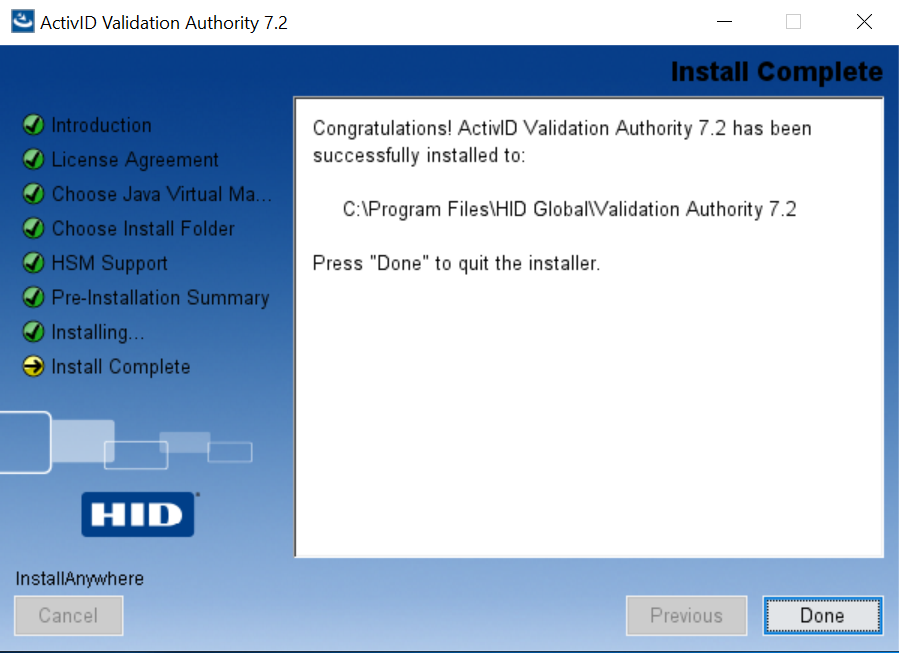
Complete the installation.
-
Open Windows Services and locate ActivID Validation Authority.
-
Right-click ActivID Validation Authority and select Properties.
-
On the General tab, set Startup type to Manual.
-
On the Log On tab, select Local System account.
-
Select Apply and then select OK.
You must configure the keys, database connection, tables, and administrator account before starting the VA server.
Apply the VA cumulative hotfix
If a cumulative hotfix is available for this VA release, download the hotfix and its README from the HID portal. Hotfixes are cumulative, so apply only the latest hotfix available for this release.
| Because the hotfix cannot be uninstalled, create a backup or VM snapshot before applying it. |
Stop the HID Validation Authority service and follow the matching vendor instructions before proceeding. Leave SQL Server and nShield services running unless the hotfix instructions state otherwise.
Configure the HID Global Validation Authority
-
Make the OCS card available in the HSM’s physical reader or slot 0.
-
From the Windows Start menu, run Configure Validation Authority and select Begin.
-
Indicate whether this is an upgrade or a new installation.
If it is an upgrade, follow the version-specific HID upgrade guidance before continuing.
-
On the next page, provide your organization name.
-
On the Keystore page:
-
Select Entrust nShield (client software v11 and later) from the drop-down menu.
-
Clear the Oracle SunJCE keystore for SSL Key check box.
-
Select Regenerate Keys to create a new set of security keys that are protected by the nShield HSM.
-
Select all four key options if this is a fresh install.
-
Under Message Digest Algorithms:
-
For the For Signatures property, select SHA-256.
-
For the For OCSP Response Data property, select SHA-256.
-
-
Under Keystore Password (Required)
-
Select Prompt for Password at Server Start.
-
Enter and confirm the OCS passphrase.

-
-
Select Next.
-
-
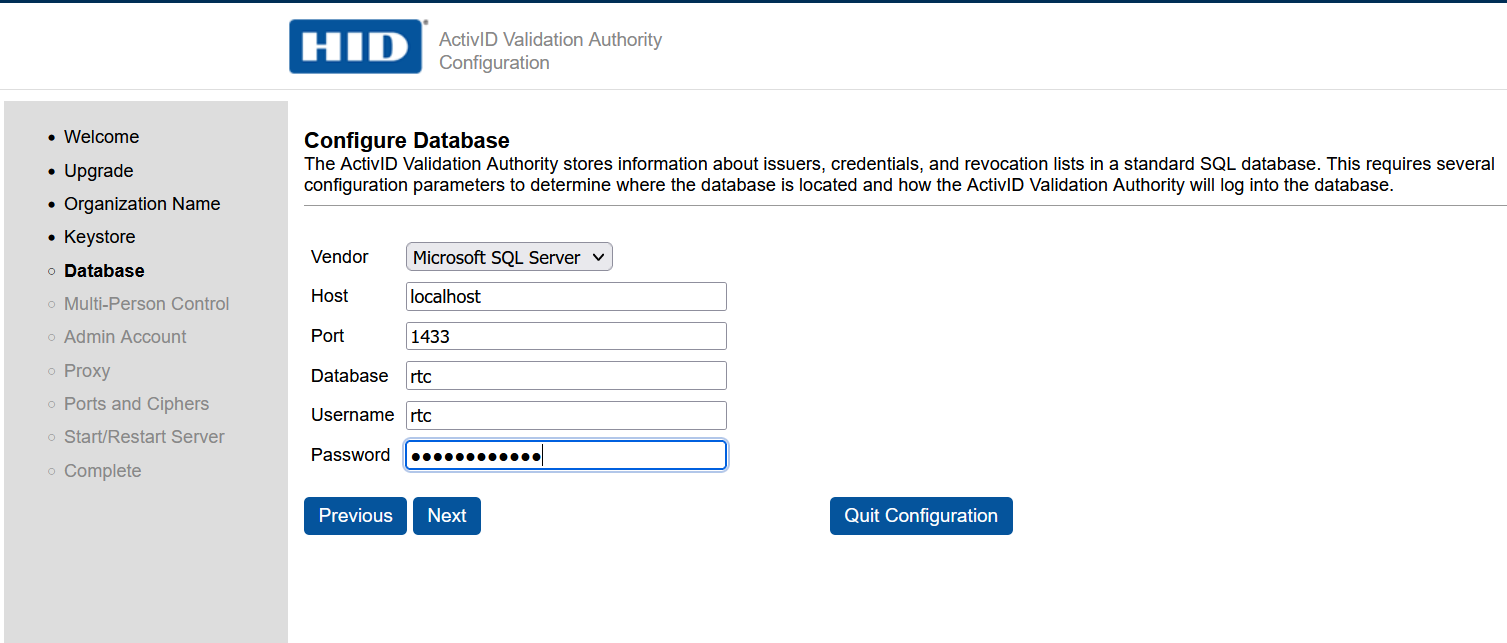
On the Configure Database page:
-
For Vendor, select Microsoft SQL Server.
-
For Host, enter localhost or the database server hostname, as applicable.
-
For Port, enter 1433.
-
For Database, enter rtc.
-
For User, enter rtc.
-
For Password, enter the
rtcSQL login password defined in Configure the HID VA database. Do not use the SQL Serversaaccount for the application connection. -
Select Next.
-
-
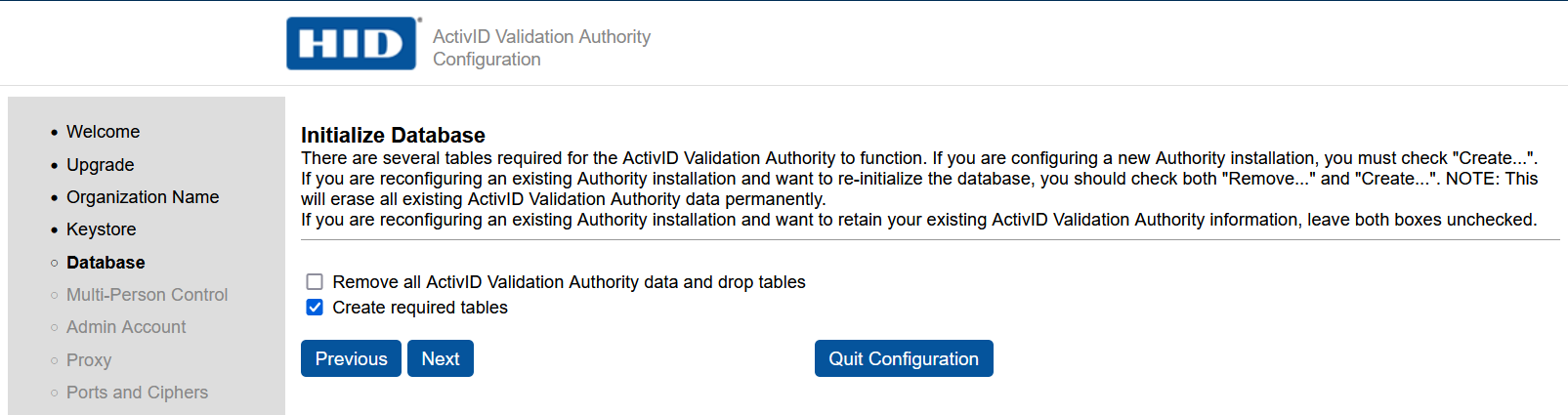
In the Initialize Database page:
-
Clear the Remove all HID Validation Authority data and drop tables check box.
-
Select Create required tables.
-
Select Next.
-
-
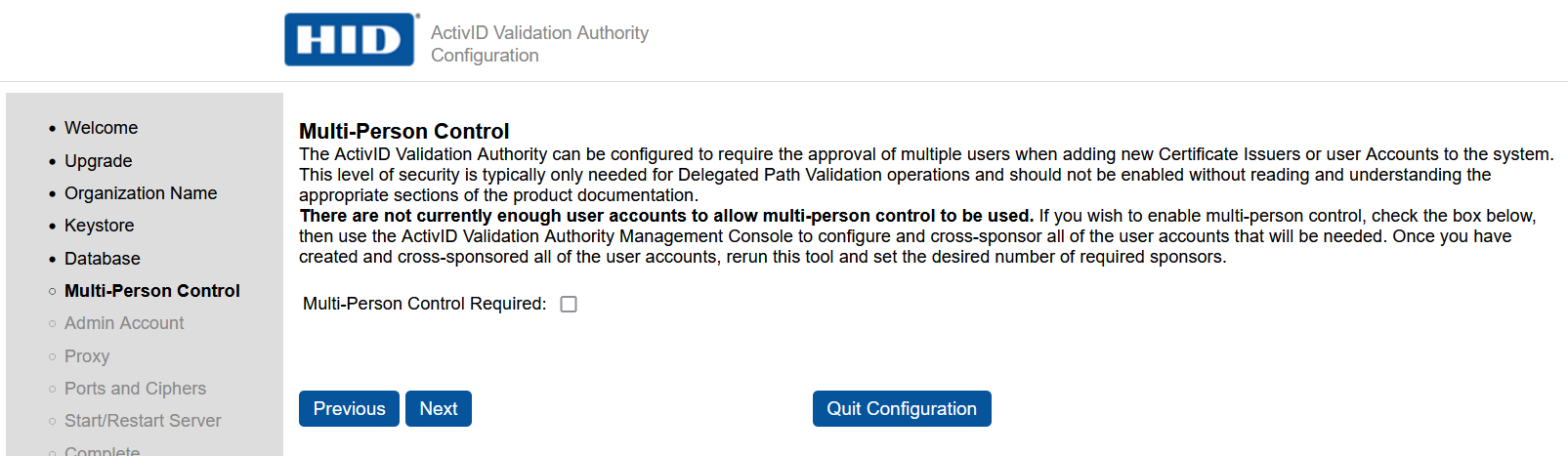
In the Multi-Person Control page, select Next.
-
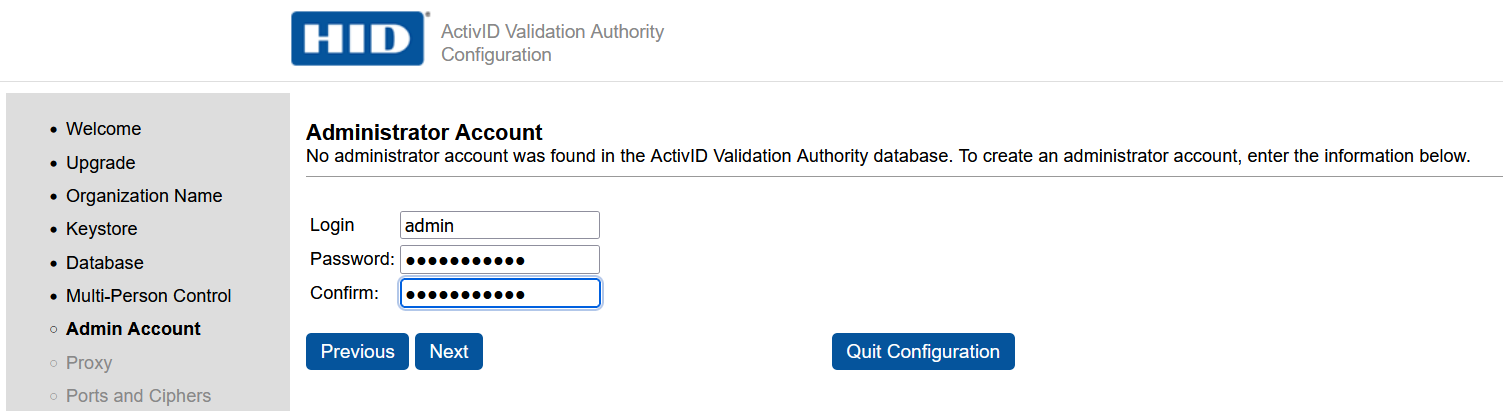
In the Administrator Account page:
-
Enter the credentials for the HID Global Validation Authority.
-
Create the HID VA administrator account according to your organization’s account and password policies.
-
Select Next.
-
-
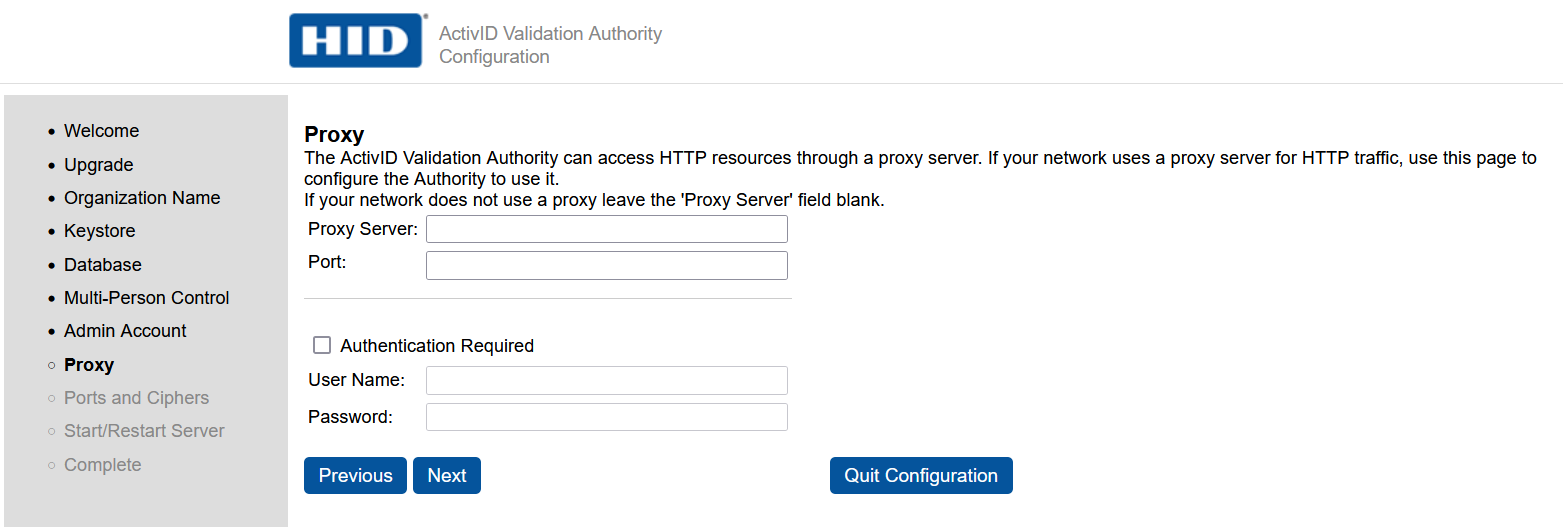
On the Proxy page, keep the defaults unless your environment requires a proxy, then select Next.
-
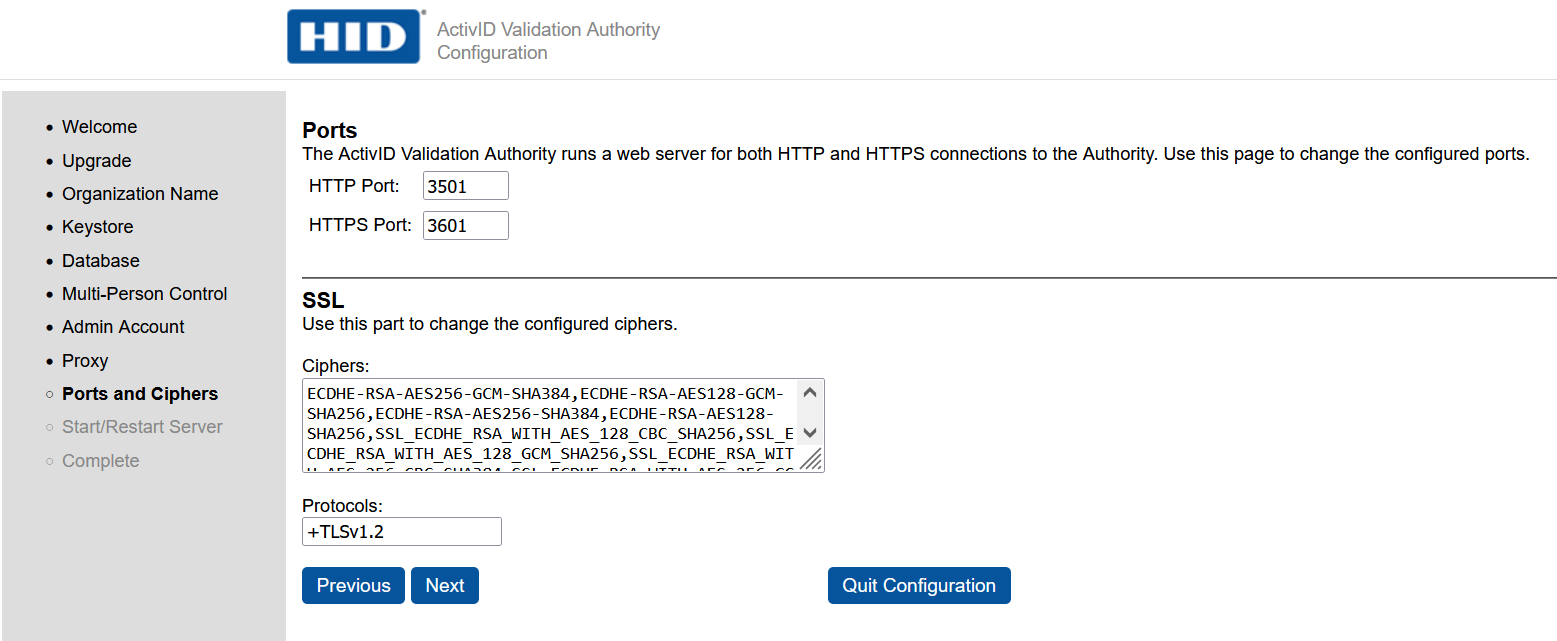
On the Ports page, keep the defaults unless your deployment requires different ports, then select Next.
-
On the Start/Restart Authority page, select Next to finish configuration without starting the service.

Close the browser when configuration is complete.
Start the HID Global Validation Authority
-
Place the OCS card in the HSM’s physical reader or in slot 0.
-
Open a command prompt in the installed VA
authority\bindirectory and start the server:server.bat start -
Enter the OCS passphrase when prompted, and keep the Tomcat terminal open.
-
Open
http://localhost:3501/monitor.jspand confirm that STATUS OK appears. -
Open the HID Validation Authority Management Console from the Windows Start menu by selecting HID Global > Validation Authority Management.
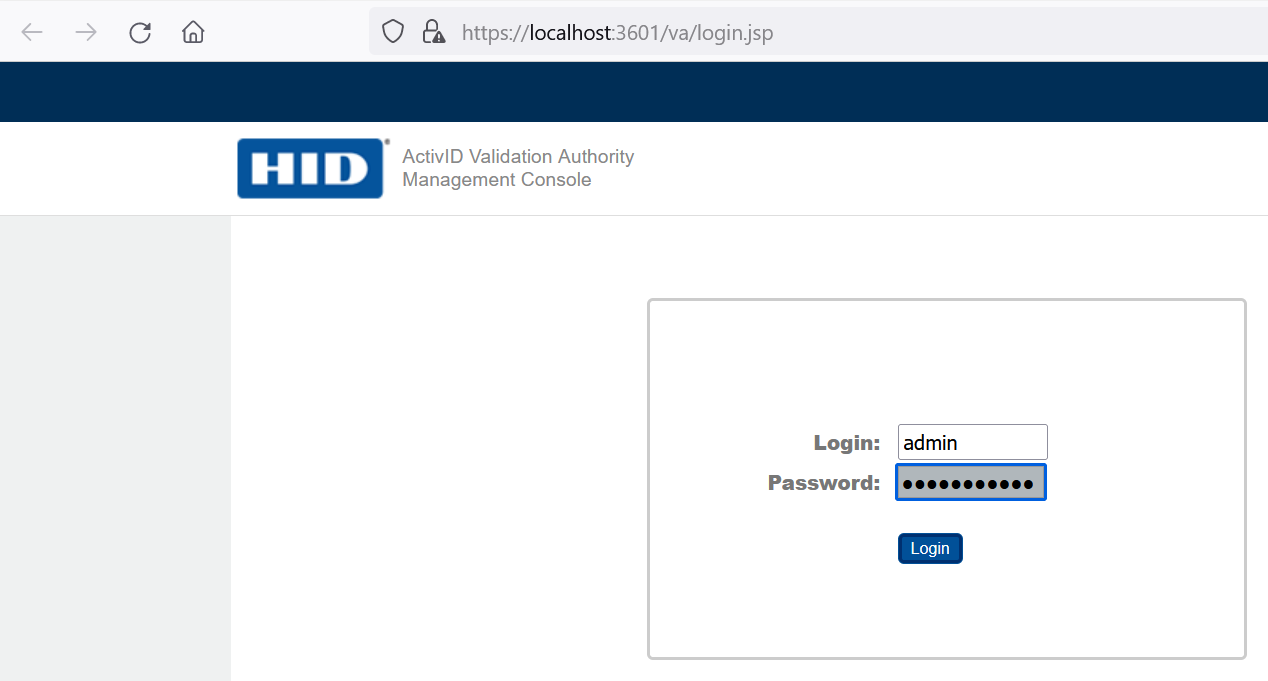
Alternatively, open
http://localhost:3501/va/login.jspand sign in with the administrator account created during configuration.
Optional OCSP test
Use an existing revoked certificate to verify that HID VA reads the issuing CA’s current base CRL and returns a signed OCSP response. HID VA acts as the responder; a separate OCSP service is not required.
Before testing:
-
Make sure that the following items are available on the server:
-
The issuing CA certificate
-
The issuing CA certificate’s current base CRL
-
The VA OCSP signing certificate available on the VA server.
-
-
Confirm that the issuing CA and base CRL are registered in HID VA.
-
Use PEM-encoded certificate files named
issuer-ca.pemandva-ocsp-signing.pem, and the CRL fileissuer-ca.crlin the working directory. -
If the certificates are DER-encoded, convert them to PEM with OpenSSL:
openssl x509 -inform DER -in issuer-ca.cer -out issuer-ca.pem
openssl x509 -inform DER -in va-ocsp-signing.cer -out va-ocsp-signing.pem
To perform the test:
-
Check that the CRL is current, is a base CRL, and contains the revoked certificate’s serial number:
certutil -dump issuer-ca.crl -
Query the local HID VA responder, entering the revoked certificate’s hexadecimal serial number with a
0xprefix:$serial = Read-Host 'Revoked certificate serial number (0x...)' openssl ocsp -issuer issuer-ca.pem -serial $serial -url http://localhost:3501/responder -VAfile va-ocsp-signing.pem -timeout 30 -
Confirm the response includes Response verify OK and
revokedfor the expected serial number, with no response-validity errors.